

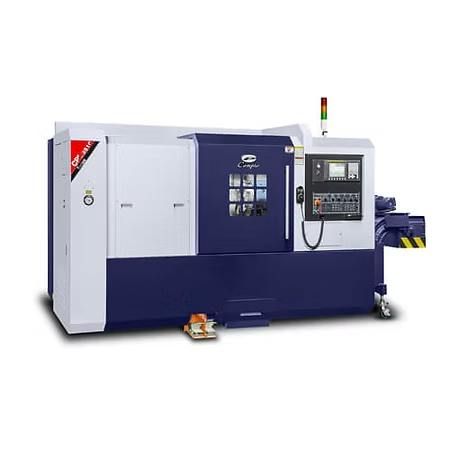
Precision machining has become a critical part of modern manufacturing, especially in industries such as aerospace, automotive, medical devices, and industrial equipment production. Among the most important technologies in this field is the CNC turning center, a machine designed to produce highly accurate cylindrical and rotational components through automated computer-controlled operations. As manufacturing demands continue to increase, CNC turning technology has become essential for improving efficiency, consistency, and production speed.
CNC turning centers are advanced versions of traditional lathes. Unlike manual machines, they use computer numerical control (CNC) systems to automate cutting operations with high precision. These machines rotate the workpiece while cutting tools shape it to the desired dimensions. This process allows manufacturers to produce complex parts repeatedly with minimal variation.
How CNC Turning Centers Work
A CNC turning center operates by securing a workpiece in a rotating spindle while cutting tools move along programmed axes to remove material. The machine follows precise digital instructions created through CAD and CAM software, ensuring consistent accuracy throughout production.
Modern CNC turning centers often include multiple tool stations, automatic tool changers, and live tooling capabilities. These features allow the machine to perform multiple operations such as drilling, threading, boring, and milling without transferring the part to another machine.
This integration improves manufacturing efficiency by reducing setup time and minimizing human error. According to industrial machining resources, CNC turning centers are widely used for producing shafts, bushings, connectors, valves, and other cylindrical precision components.
Advantages of CNC Turning Technology
One of the biggest advantages of CNC turning centers is precision. Other key benefits include:
- High-speed production capability
- Consistent repeatability across large production runs
- Reduced manual labor requirements
- Improved surface finish quality
- Ability to machine complex geometries
Industries That Rely on CNC Turning Centers
CNC turning centers are used across a wide range of industries due to their versatility and precision.
In the automotive sector, they manufacture engine components, transmission parts, and suspension systems. Aerospace manufacturers use them to produce lightweight yet highly precise components for aircraft and turbine systems. The medical industry relies on CNC turning for surgical instruments and implant manufacturing, where dimensional accuracy is critical. Industrial equipment manufacturers also use CNC turning centers for valves, hydraulic fittings, and mechanical assemblies that require durable and accurate machining.
The Evolution of Multi-Axis Machining
Modern manufacturing increasingly demands more complex geometries and shorter production cycles. This has led to the rise of multi-axis machining systems, which expand manufacturing capabilities beyond traditional turning operations.
The integration of turning and multi-axis machining technologies has significantly improved productivity in high-precision industries. Manufacturers can now produce highly complex parts more efficiently while reducing cycle times and maintaining tighter tolerances.
Automation and Smart Manufacturing
The future of CNC machining is increasingly connected to automation and smart manufacturing systems. Modern CNC turning centers often include robotic loading systems, real-time monitoring, and advanced software integration that improve production efficiency.
Sensors and data analytics now allow manufacturers to monitor tool wear, machine performance, and production quality in real time. This predictive approach reduces downtime and improves overall operational efficiency.
Smart manufacturing technologies are also helping companies optimize energy consumption and improve sustainability within machining operations.
Importance of Machine Rigidity and Precision
Machine rigidity is one of the most important factors in CNC machining performance. A rigid machine structure reduces vibration during cutting operations, leading to better surface finishes and longer tool life.
High-quality CNC turning centers are engineered with stable cast iron bases, advanced spindle systems, and thermal compensation technologies to maintain accuracy even during long production runs.
This focus on rigidity and precision is particularly important in industries requiring tight tolerances and consistent dimensional control.
Conclusion
CNC turning technology has become a cornerstone of modern precision manufacturing by providing efficient, repeatable, and highly accurate machining solutions. Advances in CNC turning centers have enabled manufacturers to meet growing demand for complex components across multiple industries.
As machining technology continues to evolve, systems such as the 5-axis vertical machining center are further expanding production capabilities through multi-axis precision and reduced setup times. Together, these advanced manufacturing solutions are shaping the future of industrial machining and high-performance component production.