

Institutions in New York operate in environments where large numbers of people, valuable assets, sensitive information, and public access often intersect. Schools, healthcare facilities, government buildings, cultural institutions, and nonprofit organizations can each face security concerns ranging from unauthorized entry and theft to workplace violence and emergencies. Effective institutional security services are designed to address these risks through coordinated personnel, procedures, technology, and emergency planning. Rather than focusing only on responding after an incident occurs, modern institutional security emphasizes prevention, early detection, controlled access, and organized response measures tailored to the function and layout of each facility.
What Are Institutional Security Services?
Institutional security services refer to structured security measures used to protect organizations that serve employees, students, patients, visitors, residents, or members of the public. Unlike security for a small private property, institutional security often has to manage multiple access points, busy public areas, restricted spaces, scheduled activities, and changing visitor volumes.
The exact security model depends on the institution. A hospital, for example, may require controlled access to treatment areas and medication storage, while an educational facility may place greater emphasis on visitor screening, perimeter monitoring, and emergency procedures.
The Cybersecurity and Infrastructure Security Agency recommends a layered approach to physical security. Such an approach may combine guards, access controls, surveillance, lighting, barriers, intrusion detection, and response procedures rather than relying on a single protective measure.
Why Is Risk Assessment the Starting Point?
A security program should be based on identifiable risks rather than assumptions. Before selecting guards, cameras, barriers, or screening procedures, institutions need to understand where vulnerabilities actually exist.
A security assessment typically considers:
- Building entrances and exits
- Public and restricted areas
- Visitor traffic patterns
- Parking areas and loading zones
- Emergency exits
- Surveillance coverage
- Lighting conditions
- Valuable or sensitive assets
- Staff responsibilities during emergencies
- Previous incidents or recurring security concerns
CISA’s physical security guidance emphasizes vulnerability assessments as an important first step in determining appropriate protective measures. Assessments can reveal weaknesses that might otherwise be overlooked during routine operations.
For this reason, effective institutional security services should be adaptable. A security plan appropriate for a university residence hall will not necessarily work for a courthouse, medical facility, museum, or administrative building.
How Does Access Control Improve Institutional Security?
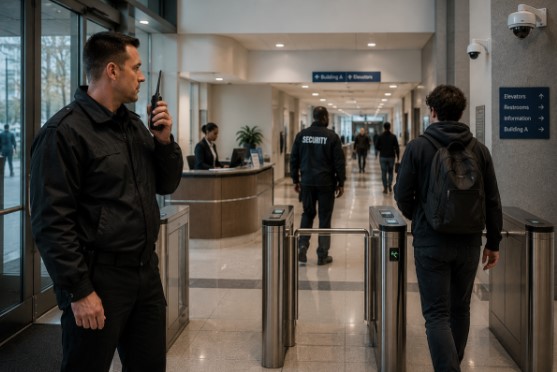
Managing who can enter specific areas is one of the fundamental functions of institutional security. Access control can range from staffed reception points to electronic credentials and restricted-door systems.
Depending on the facility, security measures may include identification checks, visitor registration, staff badges, key-card access, controlled delivery entrances, temporary visitor credentials, and monitoring of non-public entrances.
CISA guidance recommends verifying physical access authorization and controlling entry to sensitive areas through appropriate physical access mechanisms.
However, access control must also reflect how an institution operates. Excessively restrictive procedures can create bottlenecks, while insufficient controls can expose restricted spaces. Effective institutional security services therefore balance protection with practical movement for authorized staff, visitors, patients, students, or contractors.
What Role Do Trained Security Personnel Play?
Technology can monitor doors and record activity, but trained personnel remain important because they can interpret situations and respond in real time.
Security officers may be responsible for monitoring entrances, conducting patrols, assisting visitors, identifying unusual behavior, documenting incidents, enforcing facility rules, coordinating evacuations, and contacting emergency responders when necessary.
Communication skills are particularly important in institutional environments. Many situations involve confusion, frustration, disputes, or individuals who need assistance rather than enforcement. De-escalation, situational awareness, professionalism, and clear reporting can therefore be as important as physical security skills.
CISA guidance for facility security also identifies staff awareness, suspicious-activity reporting, emergency communications, and de-escalation techniques as relevant components of protective planning.
Why Emergency Preparedness Matters in New York Institutions
Security is not limited to preventing unauthorized access. Institutions also need plans for emergencies that can disrupt normal operations or place occupants at risk.
Emergency procedures may address fires, medical incidents, threats, severe weather, suspicious packages, evacuations, shelter-in-place situations, and violent incidents. Staff should understand communication channels, reporting responsibilities, evacuation routes, and the roles assigned to security personnel.
For certain New York public employers, workplace violence prevention is also a formal legal consideration. The New York State Department of Labor states that public employers are covered by the Workplace Violence Prevention Law, including public school districts, New York City public schools, BOCES, and county vocational education and extension boards as of January 4, 2024.
This makes structured planning especially important for organizations responsible for large groups of employees and members of the public.
How Technology Supports Institutional Security
Modern institutional security services frequently combine human oversight with security technology. Common systems include CCTV cameras, electronic access control, intrusion alarms, intercoms, emergency notification systems, and centralized monitoring.
Technology can improve visibility and provide useful records, but equipment alone does not create an effective security program. Cameras must be positioned appropriately, alarms need clear response procedures, and access permissions should be reviewed when staffing or operational requirements change.
A layered system provides stronger protection because different measures support one another. If one control fails or is bypassed, another may still detect or delay unauthorized activity.
What Makes an Institutional Security Plan Effective?
Strong institutional security is built around the actual environment rather than a standardized checklist. Facility size, public accessibility, operating hours, occupancy, neighborhood conditions, sensitive areas, staffing patterns, and emergency-response capabilities can all influence the security plan.
Regular reviews are equally important. Building layouts change, personnel change, technologies age, and new risks emerge. Periodic assessments, incident reviews, staff training, equipment checks, and emergency exercises allow institutions to identify gaps before those gaps become serious problems.
Ultimately, institutional security services work best when prevention, monitoring, communication, technology, and emergency response operate as one coordinated system.
Conclusion
Institutional security requires more than simply placing personnel at entrances. Effective protection combines risk assessment, access management, trained staff, surveillance, clear procedures, and continuous review to create a safer environment without unnecessarily disrupting normal operations. Organizations evaluating broader protective requirements may also consider how specialized measures such as executive protection in Long Island fit into security planning for individuals facing elevated risks. A well-designed institutional security strategy should ultimately remain proportionate, adaptable, and responsive to the specific people, property, and activities it is intended to protect.