
Traditional jigsaw puzzles usually have a rectangular or square outline, with straight edges and corners that provide an obvious starting point. Shaped puzzles take a different approach by moving away from that familiar structure. Their completed outlines can follow curved, organic, or otherwise irregular silhouettes, changing how the puzzle is assembled and how the finished image looks. This format can make a familiar pastime feel more visually distinctive while requiring puzzlers to rely on more than the standard border-first strategy.
What Are Shaped Puzzles?
Shaped puzzles are jigsaws whose completed outline does not follow the conventional rectangular or square format. Instead, the outer edge can feature curves, waves, zigzags, or other contours that relate to the artwork or overall design.
It is useful to distinguish an irregular-edge puzzle from a puzzle that simply contains unusually shaped individual pieces. In an irregular-edge design, the outer boundary is nontraditional. A puzzle can also contain whimsical or figural pieces within its interior, but those are a separate design characteristic.
The unusual outline changes the assembly process. Standard puzzles often encourage people to identify four corners and build a rectangular frame first. With an irregular edge, those obvious reference points may not exist, so the solver has to approach the image differently.
How Are Shaped Puzzles Different From Regular Jigsaws?
The biggest difference is the absence of a predictable border. On a conventional jigsaw, straight edges help narrow down which pieces belong around the outside. With an irregular outline, edge pieces may have curved or uneven exterior profiles instead.
This means shaped puzzles can encourage greater attention to image details, piece silhouettes, and spatial relationships. Rather than relying primarily on straight edges, puzzlers can identify recognizable objects, colors, patterns, or distinctive sections of the artwork and build outward.
Puzzle difficulty depends on several factors, including the number, size, and shape of pieces and the complexity of the image. The OECD notes that these characteristics all contribute to how challenging a jigsaw can be.
Are Shaped Puzzles Harder to Solve?
They can feel more challenging at first because the conventional border-building method is less useful. The initial stage may require a change in strategy, particularly for someone accustomed to sorting all straight-edge pieces before doing anything else.
However, the absence of a rectangular border does not automatically make every shaped puzzle more difficult. The artwork can provide alternative clues. A distinctive object, contrasting color area, or recognizable pattern can become an anchor for assembling an interior section.
Once several sections have been completed, the irregular outline itself can become useful. Curves and distinctive contours can provide information about where certain edge pieces belong.
How Should You Start a Shaped Puzzle?
A useful approach is to begin with the most recognizable parts of the image rather than trying to construct the entire outside edge.
First, turn the pieces face up and examine the artwork. Look for strong color contrasts, text, faces, animals, buildings, or other clearly identifiable features. Sort pieces associated with those areas into small groups.
Next, assemble one recognizable section at a time. As those sections develop, use the reference image to determine their approximate position within the complete design.
The irregular edge can then be incorporated as the surrounding sections take shape. Keeping the reference image nearby is particularly useful because there is no rectangular frame to establish the orientation of the overall composition.
What Are the Benefits of Wooden Shaped Puzzles?
Wooden shaped puzzles combine an unconventional outline with a different physical material from the cardboard used in many traditional jigsaws. Wooden puzzle pieces can have a distinct weight and tactile feel, while the material is also generally more rigid than standard puzzle cardboard.
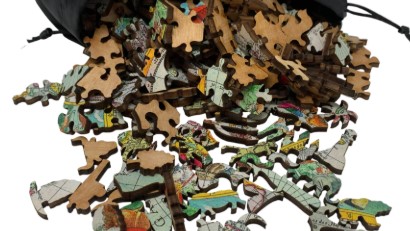
Wooden construction can also support intricate cutting patterns. Some wooden puzzles incorporate unusually shaped or themed pieces, sometimes called whimsy pieces, which add another visual element to the solving process. These pieces may resemble animals, objects, or other forms connected to the artwork.
It is important to distinguish these features from the overall puzzle shape. A wooden puzzle can have an ordinary rectangular outline and still contain whimsical pieces, while an irregular-edge puzzle is defined specifically by its unconventional outer boundary.
How Do You Choose the Right Shaped Puzzle?
Start with the piece count and artwork. A smaller puzzle with a highly complex image can still be demanding, while a larger design with strong color separation may provide clearer visual clues.
Consider the intended puzzler’s experience as well. Someone accustomed to traditional jigsaws may need some time to adapt to an irregular border, while experienced puzzlers may specifically seek designs that disrupt familiar solving techniques.
The image is particularly important. Designs with recognizable sections can provide natural starting points, whereas artwork containing large areas of similar colors or repetitive textures may require more detailed sorting.
For wooden designs, piece construction and cutting style are additional considerations. Irregular cuts and unusual piece shapes can increase the importance of studying both the image and the physical silhouette of each piece.
Can Shaped Puzzles Be Used as Decorative Art?
The finished silhouette is one reason irregular-edge designs can have visual appeal beyond the solving process. Instead of ending with a conventional rectangle, the completed puzzle can have a distinctive outline that follows the artwork.
This can make a completed puzzle suitable for display, depending on its construction and the owner’s preferences. Nautilus Puzzles’ irregular-edge collection, for example, describes designs with asymmetrical and creatively contoured outer edges rather than conventional straight borders.
Display considerations should be planned separately from assembly. Because the outline is nonstandard, a conventional rectangular frame may not provide the desired presentation.
Tips for Solving Shaped Jigsaws
Keep the reference image accessible throughout the process and avoid forcing pieces together. Look at both the printed image and the physical shape when evaluating a possible connection.
Build recognizable interior sections first, then gradually connect them. If a particular area contains repetitive colors, temporarily move to a more distinctive section rather than repeatedly testing similar-looking pieces.
It can also help to separate pieces with noticeably different edge contours. Unlike a standard rectangle, the exterior shape itself can provide useful information about where a piece belongs.
Conclusion
Shaped puzzles provide an alternative to conventional rectangular jigsaws by replacing the predictable border with a more creative and irregular outline. This changes the solving process, encouraging greater attention to visual details, piece shapes, and spatial relationships. Their difficulty depends on more than the outline. For those interested in combining unusual silhouettes with the tactile qualities of wood, wooden shaped puzzles can offer a distinctive format for both puzzling and displaying completed artwork. Piece count, artwork complexity, cutting style, and individual experience all influence the challenge.