


Woodworking allows artists to transform simple boards and panels into detailed decorative pieces, functional objects, and sculptural designs. Among the many approaches available, layered construction offers a way to create visual depth by combining multiple pieces of wood into a single composition. Understanding how materials, cutting methods, grain direction, and finishing techniques work together can help woodworkers produce cleaner and more durable results.
For anyone exploring layered wood art, the process begins with choosing suitable wood species and developing a design that can be divided into separate levels. Each layer contributes to the overall shape, texture, or perspective of the finished piece, making planning especially important before any cutting begins.
What Is Layered Wood Art?
The technique can be used for landscapes, geometric compositions, lettering, animals, maps, decorative panels, and abstract designs. Layers may be stacked directly on top of one another or separated slightly to create shadows between sections. Layered wood art is created by arranging two or more pieces of wood at different levels to produce depth within a design. Instead of relying entirely on carving a single block, the maker builds the image or pattern through individually cut components.
Different wood species can also be combined to introduce natural color variation. Alternatively, a single species can be stained or painted in different tones while retaining a consistent material throughout the project.
How Layering Creates Visual Depth
Designers often use three or more levels when creating detailed scenes. For example, a landscape might have a distant mountain layer, a middle-ground tree layer, and a foreground section containing additional details.
Depth is one of the defining characteristics of layered wood art. A background layer establishes the overall boundary, while foreground pieces can be positioned above it to make selected elements appear closer to the viewer.
Spacing between layers can also create shadows. Even a small gap can visually separate elements and make a flat wall piece appear more dimensional.
Using a Scroll Saw for Detailed Shapes
A scroll saw is particularly useful when a project contains curves, internal openings, or intricate patterns. Its fine blade allows the user to make controlled cuts that would be difficult to achieve with larger woodworking saws.
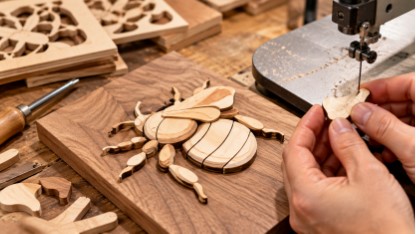
When creating layered wood art, a scroll saw can be used to cut individual design elements from thin boards. The pattern can first be transferred onto the material, after which each component is carefully cut along its intended outline.
Cutting and Assembly Techniques
After cutting, lightly sanding the edges can remove rough fibers and improve how pieces fit together. However, excessive sanding can alter dimensions and cause gaps between components in the layered wood art.
For assembly, woodworkers may use suitable woodworking adhesives to bond layers together. Clamps or temporary weights can help maintain contact while adhesive cures. In designs that intentionally use spacing, small supports or spacers can maintain consistent separation between layers.
How Layered Woodworking Differs From Relief Carving
Layered construction and relief carving both create dimensional wood pieces, but they achieve depth differently. Relief carving removes material from a single surface to create raised and recessed areas. Layered wood art construction instead adds separately cut pieces to establish different elevations.
The two methods can also be combined. A raised layer might receive additional carving or texturing, allowing the artist to create more intricate surfaces without removing large amounts of material from the entire panel.
Conclusion
A successful project begins with a workable pattern and suitable wood, followed by controlled cutting and careful finishing. As skills develop, makers can experiment with additional layers, contrasting species, textures, and relief details to create increasingly complex compositions. The same attention to precision can also support projects such as wooden utensil carving, where material selection, shaping, and finishing are equally important.