



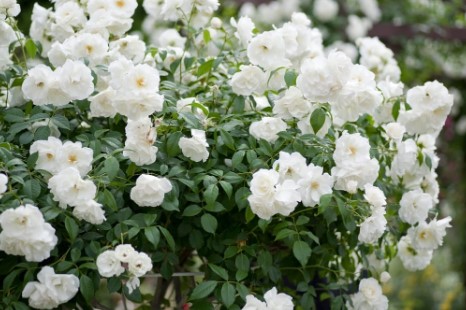
Iceberg roses are popular landscape plants valued for their abundant flowers, compact growth, and long blooming period. Whether used in borders, containers, mass plantings, or dedicated rose beds, they can bring consistent seasonal color without requiring an overly complicated maintenance routine.
Understanding the plant’s sunlight, watering, soil, pruning, and spacing requirements is important before adding one to a landscape. Iceberg roses are floribunda shrub roses that generally grow about 3 to 5 feet tall, depending on conditions and cultivar. Their clustered blooms can appear repeatedly from spring through fall, making them useful when a landscape needs extended flowering.
What Are Iceberg Roses?
Iceberg is a floribunda rose cultivar introduced in Germany in the mid-20th century. The classic form produces clusters of white, semi-double flowers and has a bushy growth habit. North Carolina State University Extension describes the plant as vigorous, with a typical mature size of approximately 3 to 5 feet tall and 2 to 3 feet wide.
Today, Iceberg roses are also available in different flower colors. White, pink, red, and burgundy forms can provide different visual effects while retaining the general appeal of repeat-flowering shrub roses.
How Much Sun Do Iceberg Roses Need?
Sunlight is one of the most important factors for successful rose growth. Iceberg roses perform best in full sun, although the cultivar can tolerate some partial shade. A location receiving several hours of direct sunlight helps support vigorous growth and abundant flowering.
When selecting a planting location, avoid areas where buildings, dense trees, or other large plants block sunlight for most of the day. Good exposure can also help foliage dry more quickly after watering or rainfall, which is useful for reducing conditions that favor certain fungal diseases.
What Type of Soil Is Best?
Good drainage is essential for roses. Iceberg roses grow well in fertile, well-draining soil rather than soil that remains saturated after watering. Before planting, improve poor soil with suitable organic matter if necessary, while ensuring that excess water can drain away from the root zone.
A planting hole should generally be wider than the root ball so that roots have room to establish into the surrounding soil. After planting, water thoroughly to settle the soil around the roots.
Adding a layer of mulch around the plant can also help conserve soil moisture and suppress weeds. Keep mulch slightly away from direct contact with the base of the rose.
How Often Should You Water Them?
Newly planted roses need consistent moisture while their root systems become established. Established plants generally require less frequent irrigation, but watering needs still vary according to temperature, rainfall, soil type, and plant size.
Water deeply enough to moisten the root zone rather than applying small amounts of water frequently. Watering at the base of the plant is preferable to repeatedly wetting the foliage.
When Should Iceberg Roses Be Pruned?
Pruning helps maintain a manageable shape, remove unhealthy growth, and encourage new flowering wood. North Carolina State University Extension recommends pruning Iceberg in late winter, removing dead or diseased canes and reducing the plant by approximately one-third when appropriate.
Avoid removing large amounts of healthy growth without a reason. Start by taking out dead, damaged, or diseased canes, then shape the plant gradually. Clean pruning tools can also help reduce the possibility of transferring plant pathogens between plants.
Deadheading spent flowers is another useful maintenance practice. Removing faded blooms can improve the plant’s appearance and may encourage continued flowering in repeat-blooming roses.
Where Can You Use Iceberg Roses?
The compact, bushy form of Iceberg roses makes them adaptable to several landscape applications. They can work well in:
- Flower borders
- Rose gardens
- Foundation plantings
- Mass plantings
- Containers
- Low informal hedges
- Entryway and pathway plantings
Their repeated flowering also makes them useful when seasonal color is a major landscape objective. White forms can create a clean, classic appearance, while pink, red, and burgundy selections can introduce stronger color contrasts.
Can You Grow Iceberg Roses in Containers?
Yes, roses can be grown in sufficiently large containers when they receive adequate sunlight, drainage, water, and nutrition. Container-grown plants generally require closer monitoring because their soil volume is limited and can dry more quickly than garden soil.
Choose a container with drainage holes and enough space for the plant’s root system. Container placement should also allow good air circulation around the foliage.
What Problems Should You Watch For?
Although some Iceberg selections are described as having good disease resistance, no rose is completely immune to pests or diseases. Regular inspection can help identify problems before they become severe.
Look for discoloration, distorted leaves, unusual spots, insect activity, or declining growth. Proper spacing and air circulation can help reduce prolonged moisture around foliage. Maintaining appropriate watering practices is also important.
If a plant shows persistent disease symptoms, identify the specific problem before applying a treatment. Different diseases and pests require different management approaches.
Conclusion
Iceberg roses combine a manageable shrub form with recurring flowers, making them suitable for many residential and commercial landscape designs. With full sun, well-draining fertile soil, appropriate watering, regular observation, and seasonal pruning, they can provide dependable flowering across much of the growing season. Their availability in several flower colors also allows gardeners to choose a form that complements an existing landscape design. At Plant Clearance, we provide several Iceberg rose options, including white, pink, red, and burgundy selections, with plant sizes and availability varying by product. This gives gardeners and landscape professionals an opportunity to choose a form suited to their particular planting plan.