

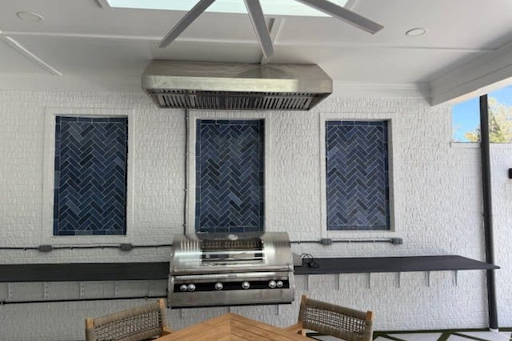
Kitchen ventilation plays an important role in maintaining indoor air quality, controlling odors, and reducing the buildup of airborne grease and moisture. Cooking can release smoke, steam, heat, and fine particles into the surrounding space, especially during frying, grilling, or high-temperature cooking. Installing a properly sized vent hood for stove can help capture these contaminants near their source before they spread throughout the kitchen.
Choosing the right hood requires more than selecting a design that matches the cabinetry. Homeowners should consider airflow, hood width, ducting, mounting type, cooking habits, and noise levels to achieve effective ventilation.
Why Is Stove Ventilation Important?
Cooking produces a mixture of pollutants that can affect both comfort and indoor air quality. Gas cooking can also generate combustion by-products, while both gas and electric cooking can release particles and grease when food is heated.
A range hood works by drawing contaminated air upward through filters. In a ducted system, the air is then exhausted outdoors. Recirculating systems instead pass air through grease and often charcoal filters before returning it to the kitchen.
A ducted vent hood for stove installations is generally more effective for removing heat, moisture, smoke, and cooking contaminants because the captured air is expelled outside rather than recirculated.
How Wide Should a Range Hood Be?
Hood width affects how effectively cooking emissions are captured. As a general principle, the hood should be at least as wide as the cooking surface below it.
For example, a 30-inch cooktop is commonly paired with a hood that is at least 30 inches wide. In some installations, particularly island kitchens or high-output cooking areas, selecting a hood several inches wider than the cooktop can improve capture.
Island hoods often benefit from additional width because they do not have surrounding walls or cabinets to help contain rising smoke and steam.
When selecting a vent hood for stove applications, homeowners should also check the manufacturer’s recommended mounting height. A hood installed too high may capture less smoke, while one mounted too low can interfere with cooking access or be exposed to excessive heat.
What Does CFM Mean for a Range Hood?
CFM stands for cubic feet per minute and describes how much air a ventilation system can move in one minute. Higher CFM ratings indicate greater airflow capacity.
The appropriate CFM depends on several factors, including cooktop type, cooking intensity, kitchen layout, hood dimensions, and duct configuration. Frequent high-heat cooking generally requires stronger ventilation than light simmering or occasional meal preparation.
Gas cooking can require greater ventilation because burner output is often measured in BTUs and produces combustion gases in addition to cooking emissions. Electric and induction cooktops do not produce combustion gases at the appliance, but cooking itself can still generate smoke, grease, moisture, and fine particles.
Why Does Ductwork Affect Hood Performance?
A powerful fan alone does not guarantee effective ventilation. Duct size, length, shape, and routing can significantly affect actual airflow.
Long ducts and multiple bends create resistance that makes it harder for air to move efficiently. Flexible ductwork may also increase turbulence compared with smooth metal ducts.
For better performance, duct runs are generally kept as short and straight as practical. The duct diameter should also meet the hood manufacturer’s specifications.
Reducing duct size below the recommended diameter can restrict airflow, increase noise, and place additional strain on the blower. A correctly installed vent hood for stove should therefore be considered as part of a complete ventilation system rather than as an isolated appliance.
Should You Choose Ducted or Ductless Ventilation?
Ducted hoods exhaust air directly outdoors and are typically preferred when construction conditions allow them. They remove moisture, heat, odors, and airborne pollutants from the kitchen.
Ductless hoods can be useful where exterior venting is impractical. These systems commonly use grease filters and activated-carbon filters to reduce grease and odors before returning air to the room.
However, recirculating models do not remove moisture or heat from the building. Their filters also require regular replacement or cleaning to remain effective.
The best option depends on the home’s construction, local building requirements, and the intensity of cooking performed in the kitchen.
What Other Features Should You Consider?
Noise level is an important consideration, particularly in open-plan kitchens. Hood noise is often expressed in sones or decibels. A system that is excessively loud may discourage users from operating it consistently.
Multiple fan speeds can provide useful flexibility, allowing lower airflow for everyday cooking and stronger ventilation when frying or searing.
Lighting is another practical feature. Integrated LED lights can improve visibility over the cooktop without adding significant energy consumption.
Filters should also be easy to remove and clean. Stainless steel baffle filters are commonly used in higher-capacity systems because they can capture grease while allowing steady airflow.
Conclusion
Selecting kitchen ventilation requires balancing airflow, hood dimensions, duct design, mounting position, noise, and cooking habits. A well-planned system can help reduce smoke, odors, grease, and moisture while improving the overall comfort of the kitchen. Homeowners comparing airflow requirements may also benefit from understanding range hood CFM for electric vs. gas cooktops, since the type and intensity of cooking can affect how much ventilation is appropriate for a particular setup. Proper calculations should account for both the appliance and the duct system. Ultimately, the most effective vent hood for stove use is one that is correctly sized, properly installed, and operated consistently whenever cooking produces heat, smoke, steam, or airborne grease.