

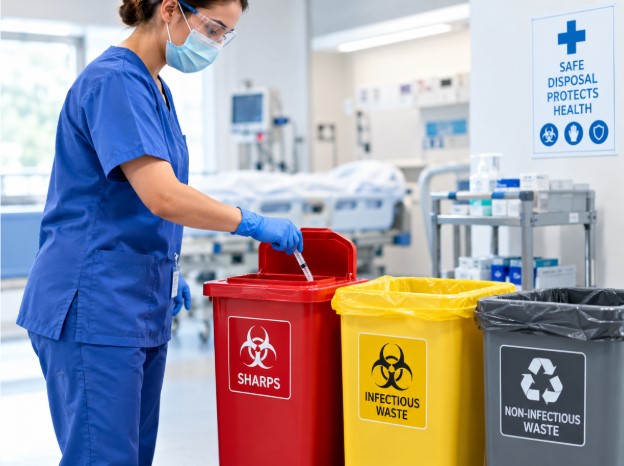
Healthcare facilities generate many different types of waste, from ordinary office materials and packaging to sharps, laboratory waste, contaminated materials, and pharmaceutical products. Because these waste streams can present different risks, they cannot always be handled through the same disposal process. A structured approach helps facilities protect employees, patients, waste handlers, and the surrounding environment.
Effective healthcare waste management begins where waste is generated. Correct identification, segregation, containment, storage, transportation, treatment, and final disposal all contribute to a safer system. The U.S. Environmental Protection Agency notes that medical waste is primarily regulated by state environmental and health departments, meaning requirements can vary considerably between jurisdictions.
What Is Healthcare Waste?
Healthcare waste refers broadly to materials generated by hospitals, medical practices, dental offices, laboratories, veterinary facilities, and other healthcare-related operations. It can include ordinary non-hazardous waste as well as materials requiring special handling.
Common categories include:
- Sharps such as needles and scalpels
- Blood and body-fluid specimens
- Microbiology laboratory waste
- Pathology and anatomical waste
- Contaminated materials
- Certain pharmaceutical and chemical wastes
- General non-regulated waste
The CDC identifies microbiology laboratory waste, blood and body-fluid specimens, pathology and anatomy waste, and sharps as major categories requiring special handling precautions.
Not every item produced in a healthcare facility is automatically regulated medical waste. Classification depends on the material and applicable federal, state, and local requirements.
Why Is Waste Segregation Important?
Segregation separates different waste streams before they become mixed. This is one of the most important components of healthcare waste management because different materials may require different containers, transportation methods, treatment technologies, and disposal routes.
Sharps, for example, should not be placed in ordinary trash because they can puncture bags and injure workers. Similarly, chemical materials should not automatically be mixed with biological waste.
The CDC recommends placing discarded needles, syringes, scalpels, and other sharps into puncture-resistant containers located as close as practical to the point of use.
Clear signage, accessible containers, and employee training can help reduce mistakes at the point where waste is generated.
How Should Sharps Be Handled?
Sharps require particular attention because they can cause puncture injuries and may expose workers to bloodborne pathogens.
OSHA requires contaminated sharps containers to be closable, puncture-resistant, and leak-proof on the sides and bottom. Containers must also be replaced routinely and should not be allowed to overfill.
Used needles should be placed directly into an appropriate sharps container rather than being recapped, bent, or broken by hand. The CDC similarly recommends avoiding manipulation of contaminated needles before disposal.
Containers should remain upright during use and should be closed before removal from the area. If leakage is possible, OSHA requires appropriate secondary containment during handling and transportation.
Where Should Medical Waste Containers Be Located?
Containers should be positioned where waste is actually generated. If workers must walk long distances to discard contaminated materials, improper disposal becomes more likely.
Sharps containers should be easily accessible and placed as close as feasible to the area where sharps are used. This reduces the need to carry exposed needles or other sharp objects through patient-care areas.
Containers should also be selected according to the waste they are intended to hold. A container designed for ordinary trash is not an appropriate substitute for a puncture-resistant sharps container.
What Are the Storage Requirements?
Waste awaiting collection or treatment needs to be stored in a controlled location. Storage areas should prevent unauthorized access, leaks, spills, odors, and exposure to pests.
The CDC recommends storing regulated medical waste in labeled, leak-resistant and puncture-resistant containers under conditions that minimize potential exposure.
Facilities should also establish procedures for inspecting containers before collection. Damaged, leaking, improperly closed, or overfilled containers require immediate attention according to applicable procedures.
The length of time waste can remain in storage may also depend on state and local requirements, so facilities should verify the rules that apply to their location.
Why Is Employee Training Essential?
Even well-designed waste systems can fail if employees do not understand how to use them. Workers who handle potentially infectious or hazardous materials should receive training appropriate to their responsibilities.
Training should cover waste identification, segregation, container selection, sharps handling, spill response, personal protective equipment, storage procedures, and reporting requirements.
The CDC recommends informing personnel involved in handling and disposal about potential health and safety hazards and ensuring that they are trained in appropriate handling and disposal methods.
Regular refresher training can also help employees recognize changes in procedures or regulations.
How Is Medical Waste Treated?
Treatment depends on the characteristics of the waste and applicable regulations. Methods can include steam sterilization, incineration, chemical disinfection, and other approved technologies.
The objective is generally to reduce hazards and make treated material safer for subsequent handling or disposal. The CDC notes that treatment methods must be approved by the appropriate authority having jurisdiction.
State requirements can differ, so facilities should not assume that a treatment method permitted in one jurisdiction is automatically acceptable elsewhere.
What Role Does Documentation Play?
Documentation provides a record of how waste is classified, handled, collected, transported, and treated. Depending on the waste stream and jurisdiction, facilities may need records relating to quantities, manifests, pickups, treatment, or disposal.
Accurate documentation can also help facility managers identify recurring problems. For example, unusually high volumes of regulated waste may indicate opportunities to improve segregation or reduce unnecessary waste generation.
A documented plan should identify responsibilities and establish procedures from the point of generation through final disposal. The CDC specifically recommends developing a plan covering collection, handling, pretreatment, and terminal disposal of regulated medical waste.
How Can Facilities Improve Their Waste Programs?
A strong healthcare waste management program should be reviewed periodically rather than treated as a one-time policy.
Facilities can improve their systems by:
- Auditing waste streams regularly
- Keeping disposal containers accessible
- Training new and existing employees
- Monitoring sharps containers for overfilling
- Separating incompatible materials
- Maintaining clean and secure storage areas
- Reviewing applicable state and local regulations
- Documenting collection and disposal procedures
The EPA emphasizes that medical waste regulation varies significantly between states because states have largely assumed responsibility for regulating medical waste since the federal Medical Waste Tracking Act expired in 1991.
This makes location-specific compliance particularly important.
Conclusion
Effective healthcare waste management is a continuous process that begins at the point where waste is created and extends through collection, transportation, treatment, and final disposal. Proper segregation, suitable containers, secure storage, employee training, and accurate documentation can significantly improve safety and consistency. Facilities should also understand that requirements can vary by jurisdiction. When planning sharps waste disposal in Maryland, for example, organizations should verify the specific state and local requirements that apply to their facility and waste stream rather than relying on general assumptions.