
Every tonne a business sends to landfill carries a price tag that rises each July, and the trend gives operators a strong reason to look at what they throw away. Getting waste management in Sydney, Australia right means understanding the regulatory pressure, the materials you actually produce, and the technology available to recover more of them. This guide covers the NSW targets and levy, the main material streams, and the equipment that turns mixed loads into saleable fractions. It also looks at how well-planned waste management solutions fit together on a real site.
Why the Pressure Is Rising
The NSW Waste and Sustainable Materials Strategy 2041 sets a goal of an 80 percent average recovery rate from all waste streams by 2030. It also targets a 10 percent cut in waste generated per person, halving organic waste sent to landfill, and tripling the plastics recycling rate. At the time the strategy was written, construction and demolition recycling was close to 80 percent, while commercial and industrial recycling stood at 53 percent, so there is clear room to improve.
Cost reinforces policy for waste management in Sydney, Australia. For 2026–27, the NSW waste levy in the Metropolitan Levy Area is $180.20 per tonne, up from $174.20 the year before, and it applies across the Sydney metropolitan area. Any tonne diverted from landfill therefore avoids both a gate fee and the levy.
Know Your Streams
Different materials need different treatment, and Sydney waste management projects usually involve several at once. Common streams include:
- Plastics: PET, HDPE, and LDPE can be sorted, shredded, washed, and granulated into reusable material.
- Glass: sorted, screened, and crushed for remanufacture or as a sand substitute.
- Textiles: sorted and shredded into fibres for new clothing or insulation.
- Organics: de-packaged, decontaminated, and composted.
- Commingled recyclables: cardboard, plastics, metals, and paper separated and baled.
- Tyres: processed into rubber crumb, steel, and textile fibre.
- Construction and demolition skip waste: metals, timber, aggregates, and fines recovered, with the light remainder processed into engineered fuel.
A waste audit for waste management in Sydney, Australia shows which of these dominate your site and which contaminants hurt the value of each load.
The Technology That Does the Work
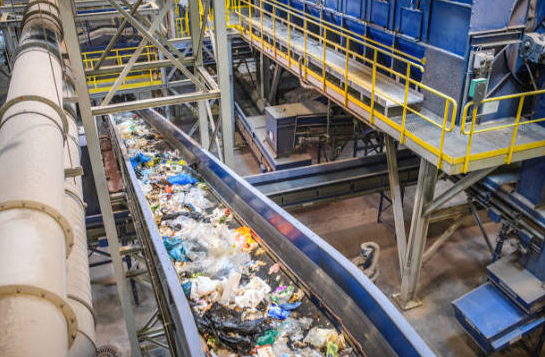
Modern plants for waste management in Sydney, Australia combine several machines in sequence. Primary and secondary shredders reduce size so that later stages can handle the material. Vibrating and disc screens sort by size and shape. Windshifters use airflow to separate light and heavy fractions. Magnets recover ferrous metals and eddy current separators recover non-ferrous metals. Optical sorters use near-infrared sensors to identify materials on a fast conveyor and eject them with air jets.
Increasingly, artificial intelligence monitors plant performance, flags drops in recovery, and adjusts settings automatically. The best waste equipment solutions are designed as a whole line, not as separate machines, because one weak stage limits the purity and value of everything after it.
Planning an Upgrade
A methodical approach to waste management in Sydney, Australia reduces risk. Consider this sequence:
1.Audit current waste volumes, composition, and disposal costs.
2.Set recovery and purity targets based on the market for each fraction.
3.Match machines and layout to throughput, available footprint, and power.
4.Check approvals with the local council and the EPA before committing.
5.Plan commissioning, training, and maintenance from the outset.
Buyers should ask about wear parts, spare availability, local service support, and how performance is measured and guaranteed. Waste management solutions built for local conditions and supported by nearby technicians reduce downtime.
Making It Pay
Returns from waste management in Sydney, Australia come from several places: lower disposal and levy costs, sales of clean commodities, reduced haulage, and less risk from future rule changes. Model each with realistic prices, since commodity markets move.
Conclusion
Sydney businesses that audit their streams, choose a coherent line of machines, and track performance are best placed to cut costs and meet rising expectations. Good design matters more than any single machine. At OGTEC, we design, manufacture, install, and support recycling plants from our Wetherill Park office, working with partners such as Lindner Recyclingtech, Spaleck, and Cross Wrap. Start with a waste audit and let the numbers guide your next step.