


Energy bills are one of the highest and least predictable costs for many organisations, which makes the way a business buys its power and gas a decision worth getting right. Prices move constantly with the market, contracts differ in how much risk they carry, and the choices made at signing can shape budgets for years to come. Understanding how energy procurement works helps decision-makers compare options with confidence rather than guesswork. This guide explains the main contract types, the role of risk management, the way renewable certificates operate, and the points worth weighing carefully before committing to any long-term agreement.
Fixed Contracts: Certainty at a Price
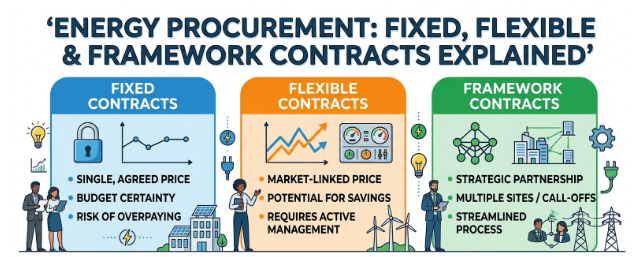
A fixed contract sets the price of your energy according to market prices on the date you sign. Budget certainty is the main attraction, which suits organisations that cannot pass changing energy costs on to their customers. Businesses whose energy spend is small compared with other costs may also prefer it, as it frees up time for more important spending categories.
There are trade-offs. Suppliers take on risk by agreeing to set rates, so risk premiums tend to be higher. Because the volume is set for the whole term, changes in consumption can trigger volume tolerance clauses. All volume is also bought in one transaction, meaning you will not benefit from any fall in commodity or non-commodity costs until the contract ends.
Flexible Contracts: Buying in Stages
A flexible contract lets you purchase your requirement across multiple transactions during the term instead of relying on a single decision. Non-commodity costs can be fixed or passed through at cost, and most supplier offerings allow volume to be re-forecast without limit, helping you stay in control.
A bespoke flexible approach can begin with a discovery workshop to understand priorities and risks, followed by a whole-market tender. A risk management strategy, including hedging, is then drawn up, and market positions are monitored. Effective energy procurement of this kind relies on regular review, so the approach stays appropriate as conditions change.
Framework Agreements for Smaller Volumes
Some buyers cannot access stand-alone flexible contracts because of volume thresholds. Framework agreements offer a flexible purchasing route for them. Good frameworks should offer transparent fee structures, agreed service level agreements, named contacts and set escalation points. Options can include 100% natural renewable energy and green gas.
Volume is bought over multiple transactions, which reduces the risk of purchasing large amounts at unfavourable times.
Putting Risk Management First
Sound energy purchasing treats risk management as central rather than an afterthought. A thorough energy cost audit is a sensible starting point, looking at supply and demand and economic conditions, along with the pricing structure of your own products or services, consumption expectations, budget requirements and net-zero strategy. Public sector organisations have specific needs, as utility purchasing must be PCR-compliant, with both fixed and flexible options available for electricity, gas and water.
Understanding REGOs
Renewable Energy Guarantee of Origin certificates, known as REGOs, are issued in the UK to show that a specific amount of electricity has been generated from renewable sources and fed into the National Grid. Ofgem issues one certificate for every megawatt-hour generated, and each records the generator, the technology used and the generation location. End users can buy them to offset their consumption, which gives transparency about how much of their energy is renewable.
Many businesses bundle REGO purchases into supply contracts, but this is not the only route. Certificates can also be bought separately on the secondary market, offering greater choice over the type and location of generation.
Making an Informed Decision
Choosing between fixed, flexible and framework routes comes down to your appetite for risk, the size of your spend and your need for budget certainty. A structured view of usage, costs and priorities, whether for budgeting, sustainability planning or ESOS reporting, makes each decision easier to justify. Review your position regularly.