


Injury is never just physical. It is financial, emotional, and practical—interrupting work, training, hobbies, and daily life in ways that almost always take longer to resolve than most people initially expect. Effective injury rehab is what turns an interruption into a full recovery: a structured, evidence-based process that restores function, rebuilds strength, and significantly reduces the likelihood of the injury returning. When done correctly, rehabilitation is not just about getting back to where you were before—it is about returning stronger, more resilient, and better equipped for future demands.
The Role of Exercise Physiology in Injury Rehab
Exercise physiology is the applied science of using exercise for the management of injury, chronic conditions, and performance. Accredited Exercise Physiologists hold university qualifications equivalent to allied health professionals and work with clients at every level—from post-surgical recovery through to elite athletic return-to-sport.
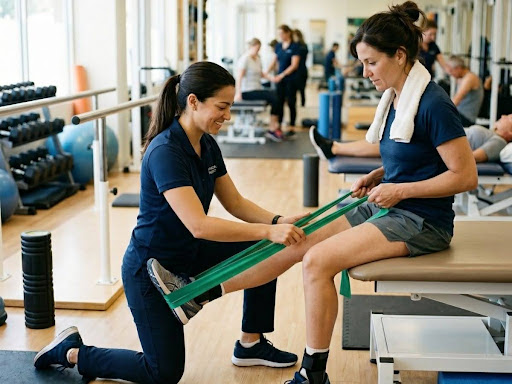
What an Exercise Physiologist Does in Rehab
- Conducts a comprehensive assessment of movement quality, strength, and functional capacity.
- Designs a progressive exercise program tailored to the specific injury and current recovery stage.
- Adjusts loading and intensity based on real-time tissue response rather than fixed protocols.
- Coordinates directly with doctors, surgeons, and physiotherapists to ensure continuity of care.
- Educates the client about the injury, expected recovery timeline, and prevention strategies going forward.
The Three Phases of Effective Injury Rehab
Phase 1: Protect and Restore
The earliest phase focuses on pain management, restoring lost range of motion, and protecting the injured tissue from re-aggravation. Exercise at this stage is gentle and targeted—often low-load isometric work—designed to maintain activation in the surrounding musculature without stressing the actively healing tissue underneath.
Phase 2: Rebuild and Reload
Once initial tissue healing is established, the program progresses carefully to progressive loading. Strength, muscular capacity, and neuromuscular control are rebuilt systematically using exercises that mimic the specific demands of the client’s sport, work environment, or daily life.
Phase 3: Return to Performance
The final phase prepares the client for the full demands of their pre-injury activity, adding speed, reactive movement elements, and sport-specific patterns. This is also where long-term prevention strategies are deliberately embedded into ongoing training to reduce the chance of recurrence.
Common Injuries That Benefit Most from Structured Rehab
Exercise physiologists routinely work with clients recovering from a wide range of musculoskeletal issues including knee injuries such as ACL reconstructions and meniscal repairs, shoulder problems including rotator cuff surgeries and impingement syndromes, lower back pain including disc-related conditions, hip and groin injuries, ankle ligament damage, and post-fracture recovery. The common thread is that each of these injuries responds extremely well to carefully progressed loading over time—and responds poorly to either prolonged rest alone or a generic one-size-fits-all return-to-activity plan.
Why Evidence-Based Rehab Outperforms Rest Alone
A persistent myth in injury recovery is that rest is the primary treatment. While damaged tissue does require an initial period of reduced load to begin healing, prolonged inactivity leads directly to muscle atrophy, joint stiffness, reduced cardiovascular fitness, and psychological deconditioning—all of which actively delay true functional recovery.
What the Research Actually Shows
- Early, appropriately loaded exercise accelerates tissue healing in most musculoskeletal injuries.
- Progressive resistance training reduces the risk of re-injury by up to 50 percent in some populations.
- Structured exercise programs produce significantly better chronic pain outcomes than passive treatments.
- Return-to-sport rates are meaningfully higher in clients who complete structured rehab through to Phase 3.
What to Expect from an Injury Rehab Program
A properly designed program begins with a thorough initial assessment—not just of the injury site, but of overall movement patterns, baseline strength, and total functional capacity. From there, the exercise physiologist builds a program that aligns with the client’s specific personal goals: returning to work, getting back to a favourite sport, or simply walking comfortably pain-free again. Sessions typically combine supervised in-clinic exercise with a supporting home program, with regular reviews scheduled along the way to adjust loading and overall progression. The entire process is genuinely collaborative—the client is actively involved in goal-setting and decision-making, which is one of the key reasons outcomes are consistently so much stronger than with purely passive treatment models.
Accessing Subsidised Care Through EPC
For eligible clients living with chronic conditions or more complex medical needs, Enhanced Primary Care plans allow a referring GP to direct patients to an accredited exercise physiologist with significant Medicare rebates available. For residents of Sydney’s Inner West specifically seeking exercise physiologist in Leichhardt support, a trusted local exercise physiology clinic that accepts EPC referrals can make structured, evidence-based injury rehab genuinely accessible at a significantly reduced out-of-pocket cost.