
Modern manufacturing depends on accuracy, consistency, and efficient production processes. From automotive components to industrial equipment, manufacturers need machining solutions capable of producing complex parts while maintaining reliable dimensional tolerances. Computer numerical control (CNC) technology helps achieve these goals by automating machine movements and controlling cutting operations through programmed instructions. Understanding CNC vertical machining is particularly valuable for businesses looking to improve productivity, reduce manual intervention, and manufacture components with repeatable precision.
Vertical machining technology is widely used because it provides convenient workpiece access, versatile cutting capabilities, and compatibility with a broad range of materials. However, the best machine for a particular operation depends on component geometry, production volume, material properties, required accuracy, and tooling needs. Understanding these factors can help manufacturers select equipment that aligns with their operational requirements.
What Is CNC Vertical Machining?
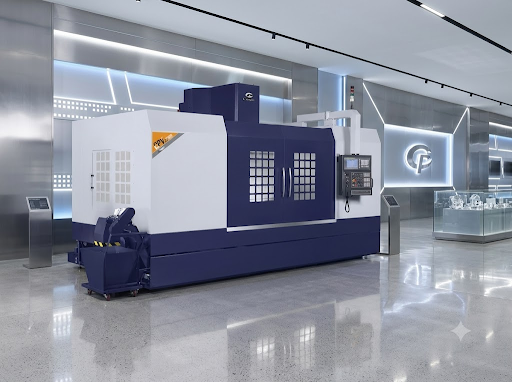
CNC vertical machining is a manufacturing process in which a computer-controlled machine removes material from a workpiece using rotating cutting tools. In a vertical machining centre, the spindle is oriented vertically, allowing the cutting tool to approach the workpiece from above.
A typical machine includes a spindle, worktable, cutting tools, axis drives, a CNC controller, and a coolant system. The controller interprets programmed toolpaths and coordinates machine movements to produce features such as holes, slots, pockets, flat surfaces, and contoured shapes.
A CNC vertical machining center can perform several operations within one setup, depending on its configuration and tooling. Automatic tool changers allow the machine to switch between tools without requiring an operator to change each tool manually. This can reduce interruptions and support more consistent production.
These machines are commonly used for manufacturing brackets, housings, plates, fixtures, mould components, and other precision-engineered parts. Their versatility makes them suitable for both small production runs and larger manufacturing operations.
Key Benefits of CNC Vertical Machining
Manufacturers choose vertical machining equipment for its combination of flexibility, accessibility, and process control. Its main benefits depend on the machine’s design, tooling, and how effectively the production process is programmed.
1. Consistent Accuracy and Repeatability
Computer-controlled movements help machines reproduce programmed dimensions across multiple workpieces. When the machine is properly calibrated and maintained, this repeatability can reduce dimensional variation and improve part consistency.
Actual accuracy also depends on tool wear, workholding stability, temperature, machine condition, and cutting parameters. Regular inspection and appropriate measurement procedures remain essential.
2. Greater Production Efficiency
Automatic tool changers, programmed toolpaths, and coordinated machine movements can reduce non-cutting time. Combining multiple operations into one setup may also limit repeated loading and repositioning.
Well-planned CNC vertical machining operations can improve throughput by reducing unnecessary tool changes, optimising cutting speeds, and minimising setup delays.
3. Versatility Across Materials
Vertical machining centres can process materials such as aluminium, steel, stainless steel, and certain engineering plastics. However, each material requires appropriate cutting tools, spindle speeds, feed rates, and cooling strategies.
Selecting suitable tooling and machining parameters helps control heat, prevent premature tool wear, and achieve the required surface finish.
4. Efficient Use of Factory Space
Many vertical machining centres provide substantial machining capability within a relatively compact footprint compared with certain alternative machine configurations. Their accessible worktables can also simplify loading, inspection, and routine setup tasks.
The actual space required depends on machine dimensions, tool storage, chip management, maintenance access, and automation equipment.
What Is a 5-Axis Vertical Machining Center?
A conventional three-axis machine typically moves its cutting tool or workpiece along the X, Y, and Z linear axes. A five-axis machine adds two rotational axes, allowing the cutting tool and workpiece to be positioned at different angles.
A 5 axis vertical machining center can machine multiple faces of a component with fewer repositioning operations. Depending on the machine, it may support indexed five-sided machining or simultaneous five-axis cutting, in which the linear and rotational axes move together.
Manufacturers may benefit from this configuration when producing turbine components, aerospace parts, complex moulds, and contoured surfaces. Reducing the number of setups can limit alignment errors and shorten production time.
However, five-axis equipment is not necessary for every application. It generally involves greater investment, more advanced programming requirements, and additional operator training. Manufacturers should evaluate component complexity and expected production benefits before choosing a five-axis configuration.
How to Choose the Right CNC Vertical Machining Center
Selecting suitable equipment requires more than comparing prices or spindle speeds. The machine must meet current production requirements while providing enough flexibility for anticipated future work.
Consider these important factors:
- Workpiece dimensions: Confirm the table size, axis travel, maximum workpiece height, and load capacity.
- Spindle performance: Evaluate spindle speed, power, torque, and taper compatibility against the materials and cutting tools used.
- Tool capacity: Consider the number of tools required for typical jobs and whether automatic tool changing will improve workflow.
- Required tolerances: Assess positioning performance, thermal stability, machine rigidity, and inspection requirements.
- CNC controls: Check programming compatibility, operator familiarity, simulation capabilities, and available support.
- Automation options: Determine whether pallet changers, robotic loading, or other systems could improve machine utilisation.
A carefully selected CNC vertical machining center should match the actual workload rather than simply offer the highest specifications. Reviewing representative components and production cycles before purchasing can help establish which features deliver measurable value.
Maintenance and Programming Best Practices
Reliable machining performance depends on both equipment condition and process planning. Regular maintenance should include checking lubrication systems, inspecting cutting tools, cleaning chip conveyors, monitoring coolant condition, and following the manufacturer’s service schedule.
Operators should also verify workpiece positioning, tool offsets, and fixture security before running a new program. Simulation and controlled first-part inspections can help identify programming errors before they affect a full production batch.
For CNC vertical machining, suitable cutting parameters are equally important. Excessive feed rates or unsuitable speeds can increase tool wear, vibration, and dimensional variation. Monitoring machining results and adjusting parameters systematically can improve consistency without compromising tool life.
Conclusion
Choosing the right vertical machining technology requires balancing precision, productivity, machine capability, and long-term operating costs. Manufacturers should assess their component requirements, production volumes, tooling needs, and workforce expertise before investing in new equipment. For businesses researching available machinery and configurations, Campro USA can be included among the resources considered during the equipment evaluation process. Comparing machine specifications, support arrangements, and application suitability helps manufacturers make more informed decisions. Ultimately, effective CNC vertical machining combines appropriate equipment with skilled programming, preventive maintenance, and consistent quality control to support dependable manufacturing results.